Searches for Radhe Exchange often overlap with cricket exchange terminology. These definitions explain the mechanics without recommending a platform or a wager.
A position that a selected outcome will happen. The displayed price is commonly used to calculate a potential return.
Lay
A position that a selected outcome will not happen. The person laying can face liability greater than the amount they hope to gain.
Odds
A representation of price and implied probability. Odds moving does not make an outcome certain.
Liquidity
The amount available to match at quoted prices. A displayed price may not remain available for the full amount.
Liability
The amount that may be lost on a position, particularly when laying an outcome.
Settlement
The application of published market rules after an event. Ambiguous, abandoned or corrected events can create disputes.
Simple illustration
Price is not prediction
Decimal odds of 2.00 can be read as an implied probability of 50% before margin and market effects. It does not mean an outcome is “due,” and changing odds do not create certainty.
Implied probability1 ÷ decimal odds
Common questions
Quick answers
Is an exchange the same as a bookmaker?+
The matching model can differ, but both can involve staking money on uncertain outcomes. Legal and financial risk remains.
Does better-looking odds mean a safe platform?+
No. A price says nothing about legal identity, security, withdrawal reliability or complaint handling.
Do you publish match tips?+
No. This guide does not provide predictions or wagering recommendations.
Detailed practical guide
A complete working method for cricket exchange terminology
Direct answer: The useful way to approach this topic is to slow the sequence down: establish the exact task, verify back, lay, liability and settlement, calculate what could be exposed, and decide a stop rule before responding to a cricket market screen filled with moving numbers. Understand the financial meaning before interpreting the sporting display. This page is information; it does not create accounts, authenticate users, receive funds or confirm an operator.
The goal is reading exchange-style prices and market labels without confusing them with predictions. That requires more than recognising the Radhe Exchange name. It requires a chain of evidence in which each important claim has an accountable source, each request has a clear purpose, and every personal limit remains effective even when a page or person creates urgency. When an answer cannot be verified, “not established” is more accurate than either trust or accusation.
Use the sections below as a worksheet for cricket exchange terminology. They organise terminology, actions, decision signals, mistakes and realistic situations around one practical rule: Understand the financial meaning before interpreting the sporting display. They do not promise availability, legality, safety, winnings, withdrawals or operator conduct; such claims require current evidence independent of a cricket market screen filled with moving numbers.
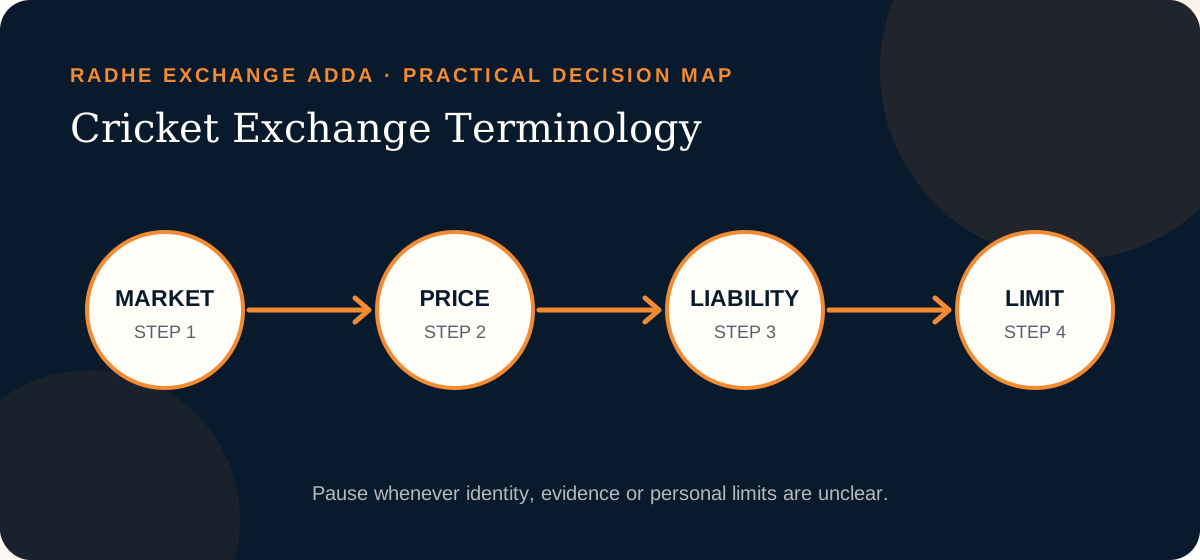
Radhe Exchange Adda decision map: move from evidence to limits and stop whenever a material check remains unresolved.
Terminology
Words that matter when assessing cricket exchange terminology
In a cricket exchange terminology decision, familiar terms may carry a precise security, legal or financial meaning. These conservative definitions help a reader evaluate back, lay, liability and settlement without allowing a promotional phrase or a cricket market screen filled with moving numbers to stand in for evidence.
Odds
A price that combines probability assumptions, market activity and commercial margin. In this cricket exchange terminology context, use the term precisely: ask who supplies the information, what can be checked, and what consequence follows if the assumption is wrong. Clear vocabulary keeps a persuasive label from doing the work of evidence.
Implied probability
A mathematical interpretation of a price, not a guarantee that the event will occur. In this cricket exchange terminology context, use the term precisely: ask who supplies the information, what can be checked, and what consequence follows if the assumption is wrong. Clear vocabulary keeps a persuasive label from doing the work of evidence.
Liability
The amount exposed to loss under a position, especially when laying an outcome. In this cricket exchange terminology context, use the term precisely: ask who supplies the information, what can be checked, and what consequence follows if the assumption is wrong. Clear vocabulary keeps a persuasive label from doing the work of evidence.
Settlement rule
The written method used to decide how a market is graded after interruptions or unusual events. In this cricket exchange terminology context, use the term precisely: ask who supplies the information, what can be checked, and what consequence follows if the assumption is wrong. Clear vocabulary keeps a persuasive label from doing the work of evidence.
Variance
The ordinary gap between an expected result over time and what happens in a short sequence. In this cricket exchange terminology context, use the term precisely: ask who supplies the information, what can be checked, and what consequence follows if the assumption is wrong. Clear vocabulary keeps a persuasive label from doing the work of evidence.
Step by step
Five ordered checks for cricket exchange terminology
The order supports the goal of reading exchange-style prices and market labels without confusing them with predictions. Starting with a cricket market screen filled with moving numbers lets another party control the route; starting with the task, source and limits keeps this cricket exchange terminology decision reversible until the important questions are answered.
Define the market
Write the exact outcome, time window and settlement condition. Similar labels can settle differently after weather, substitutions or abandoned play. For this cricket exchange terminology check, record what you inspected and which source supported it. If the answer depends only on a cricket market screen filled with moving numbers, mark it unresolved instead of filling the gap with confidence.
Translate the price
Convert the odds to an approximate implied probability and remember that price includes market and commercial effects. It is not a promise. For this cricket exchange terminology check, record what you inspected and which source supported it. If the answer depends only on a cricket market screen filled with moving numbers, mark it unresolved instead of filling the gap with confidence.
Calculate loss first
State the maximum amount that can be lost before thinking about profit. For lay-style positions, calculate liability rather than looking only at the stake. For this cricket exchange terminology check, record what you inspected and which source supported it. If the answer depends only on a cricket market screen filled with moving numbers, mark it unresolved instead of filling the gap with confidence.
Remove the fan narrative
Ask whether loyalty, recent highlights or confidence in a player is being mistaken for evidence. Familiarity can make uncertainty feel smaller than it is. For this cricket exchange terminology check, record what you inspected and which source supported it. If the answer depends only on a cricket market screen filled with moving numbers, mark it unresolved instead of filling the gap with confidence.
Apply a fixed boundary
Use an affordable limit and do not expand it because an innings, over or result felt unlucky. Variance does not create a debt that the next wager must repay. For this cricket exchange terminology check, record what you inspected and which source supported it. If the answer depends only on a cricket market screen filled with moving numbers, mark it unresolved instead of filling the gap with confidence.
Decision table
Turn cricket exchange terminology signals into specific responses
A signal matters when it changes behaviour. For cricket exchange terminology, the table avoids unsupported “safe” or “unsafe” labels and instead connects each observation about back, lay, liability and settlement to a proportionate next action.
Signal
Why it matters
Safer response
Knowledge illusion
Knowing teams and conditions can be mistaken for certainty about price.
Separate sports analysis from probability and loss calculation. For cricket exchange terminology, keep the next action proportionate to the possible exposure.
Small-odds comfort
A likely event can still lose, and repeated exposure compounds risk.
Judge total exposure rather than one attractive price. For cricket exchange terminology, keep the next action proportionate to the possible exposure.
In-play urgency
Rapid changes reduce time for settlement and affordability checks.
Skip decisions that cannot survive a deliberate pause. For cricket exchange terminology, keep the next action proportionate to the possible exposure.
Loss narrative
An unlucky result can create pressure to correct the story financially.
End the session at the preset boundary and do not chase. For cricket exchange terminology, keep the next action proportionate to the possible exposure.
Verification notes
Build a concise record for cricket exchange terminology
Write down the unresolved point
For cricket exchange terminology, record the exact question before opening another result or message. The working question is whether back, lay, liability and settlement can support the goal of reading exchange-style prices and market labels without confusing them with predictions. Note the hostname, date, source and the claim in its original context. This small record prevents a later page from quietly changing the issue and makes “still unknown” a usable conclusion rather than an uncomfortable gap.
Compare conflicts by source quality
When two pages disagree about cricket exchange terminology, do not count how many repeat each position. Ask which source is accountable, current, independent of a cricket market screen filled with moving numbers, and directly relevant to the fact being checked. Prefer a narrow supported statement over a broad reassuring one. If neither side meets that standard, retain both links, label the conflict unresolved and avoid any action that would expose credentials, identity, device access or money.
Record why you stopped
A no-action decision protects future choices. Write the stop reason in practical language: the identity was unclear, the terms could not be retained, the legal context needed advice, or the request exceeded the chosen limit. For this cricket exchange terminology page, use this standing rule: Understand the financial meaning before interpreting the sporting display. Recording the reason reduces the chance that a later countdown, different contact or newly designed page restarts the same decision without resolving the original problem.
Risks and common mistakes
Where a cricket exchange terminology decision can lose focus
For cricket exchange terminology, mistakes often begin with a cricket market screen filled with moving numbers, a plausible explanation or one small exception—not deliberate recklessness. Naming those patterns before working toward this page’s goal—reading exchange-style prices and market labels without confusing them with predictions—makes them easier to recognise under pressure.
Knowledge illusion
Knowing teams and conditions can be mistaken for certainty about price. This matters when the practical task is reading exchange-style prices and market labels without confusing them with predictions. The safer response is simple: separate sports analysis from probability and loss calculation. A pause preserves choices; urgency usually removes them.
Small-odds comfort
A likely event can still lose, and repeated exposure compounds risk. This matters when the practical task is reading exchange-style prices and market labels without confusing them with predictions. The safer response is simple: judge total exposure rather than one attractive price. A pause preserves choices; urgency usually removes them.
In-play urgency
Rapid changes reduce time for settlement and affordability checks. This matters when the practical task is reading exchange-style prices and market labels without confusing them with predictions. The safer response is simple: skip decisions that cannot survive a deliberate pause. A pause preserves choices; urgency usually removes them.
Loss narrative
An unlucky result can create pressure to correct the story financially. This matters when the practical task is reading exchange-style prices and market labels without confusing them with predictions. The safer response is simple: end the session at the preset boundary and do not chase. A pause preserves choices; urgency usually removes them.
Practical scenarios
Three realistic cricket exchange terminology situations
These are decision exercises, not claims about Radhe Exchange operations. Each applies the rule “understand the financial meaning before interpreting the sporting display” while showing how a reader can preserve credentials, money, data or wellbeing without guessing the sender’s motive.
A favourite is heavily backed
Situation: The team looks dominant and the displayed price feels like confirmation.
Reasoned response for cricket exchange terminology: The reader calculates implied probability and loss, then recognises that popularity and certainty are different. The useful result for a Radhe Exchange reader is a controlled process, not a perfect prediction or a decision dictated by one unverified prompt.
Rain changes the match
Situation: An in-play market continues while playing conditions and possible settlement rules change.
Reasoned response for cricket exchange terminology: The reader avoids guessing how the market will be graded and checks the written rule before any decision. The useful result for a Radhe Exchange reader is a controlled process, not a perfect prediction or a decision dictated by one unverified prompt.
A narrow loss feels unfair
Situation: The last selection missed by a small margin, creating an urge to increase the next stake.
Reasoned response for cricket exchange terminology: The session ends at the planned boundary because closeness does not make a later outcome owe a recovery. The useful result for a Radhe Exchange reader is a controlled process, not a perfect prediction or a decision dictated by one unverified prompt.
Questions and answers
Focused answers about cricket exchange terminology
What is the first check for cricket exchange terminology?
State the exact task and expected destination before acting. Then test back, lay, liability and settlement through a source that is independent of a cricket market screen filled with moving numbers. This prevents a broad brand search from becoming accidental consent, credential disclosure or payment. This editorial guide cannot make the decision safe by itself; it can only make the unresolved questions visible.
Does a polished Radhe Exchange page prove it is official?
No. For cricket exchange terminology, design, HTTPS, logos and search position can be useful technical or navigation signals, but none establishes operator identity on its own. Confirm the accountable party and exact hostname outside the page before relying on official-looking presentation. This editorial guide cannot make the decision safe by itself; it can only make the unresolved questions visible.
What should I save while checking?
Keep the exact URL, relevant terms, recipient or publisher details, timestamps and the source used for verification. For cricket exchange terminology, a contemporaneous record is more reliable than remembering a screen after it changes or disappears. This editorial guide cannot make the decision safe by itself; it can only make the unresolved questions visible.
When is leaving the right decision?
Leave when pressure rises while identity, legality, terms or personal limits remain unclear. Also stop at any request for a password, OTP, UPI PIN, remote-control access or unexplained payment. Understand the financial meaning before interpreting the sporting display. This editorial guide cannot make the decision safe by itself; it can only make the unresolved questions visible.
Related next steps
Choose the next guide after this cricket exchange terminology check
Keep the goal of reading exchange-style prices and market labels without confusing them with predictions separate from later access, registration, payment or legal questions. If the task changes, open the matching guide and begin again with its evidence. Do not carry trust from a cricket market screen filled with moving numbers into another domain, person or decision without verification.
Hello! 👋 Do you want to Create your IPL Cricket Betting ID ?
Kisi bhi top bookie (Reddy Anna, Lotus, etc.) se apni Betting ID lo, fatak se 60 seconds mein. Tension-free khelo kyunki humara 24/7 live chat support hamesha aapke saath hai.