Published legal entityA named contracting partyStill needs verification
Consistent, verifiable recordsTraceable identity and termsMust match the exact service
Step by step
Before dealing with an account intermediary
1
Capture the exact identity
Record the full phone number, handle, domain and entity claim before sending anything.
2
Compare independent records
Look for consistent details outside the seller’s own messages. Conflicting domains or names are a reason to stop.
3
Set a data boundary
Never provide passwords, OTPs, PINs or remote device access. Avoid identity documents until the controller and purpose are clear.
4
Reject urgency
“Offer ends now,” guaranteed withdrawals and instant-profit claims are pressure tactics, not evidence.
We are not an ID provider
Radhe Exchange India does not issue accounts, recover credentials, accept documents or operate messaging support. We do not endorse any number or handle found in search results.
Detailed practical guide
A complete working method for Radhe Exchange ID-provider claims
Direct answer: The useful way to approach this topic is to slow the sequence down: establish the exact task, verify identity, authority and secure communication, calculate what could be exposed, and decide a stop rule before responding to a person offering an ID through messaging or asking for documents. A confident claim of affiliation is not proof of authority. This page is information; it does not create accounts, authenticate users, receive funds or confirm an operator.
The goal is testing whether an agent or account seller has a verifiable role. That requires more than recognising the Radhe Exchange name. It requires a chain of evidence in which each important claim has an accountable source, each request has a clear purpose, and every personal limit remains effective even when a page or person creates urgency. When an answer cannot be verified, “not established” is more accurate than either trust or accusation.
Use the sections below as a worksheet for Radhe Exchange ID-provider claims. They organise terminology, actions, decision signals, mistakes and realistic situations around one practical rule: A confident claim of affiliation is not proof of authority. They do not promise availability, legality, safety, winnings, withdrawals or operator conduct; such claims require current evidence independent of a person offering an ID through messaging or asking for documents.
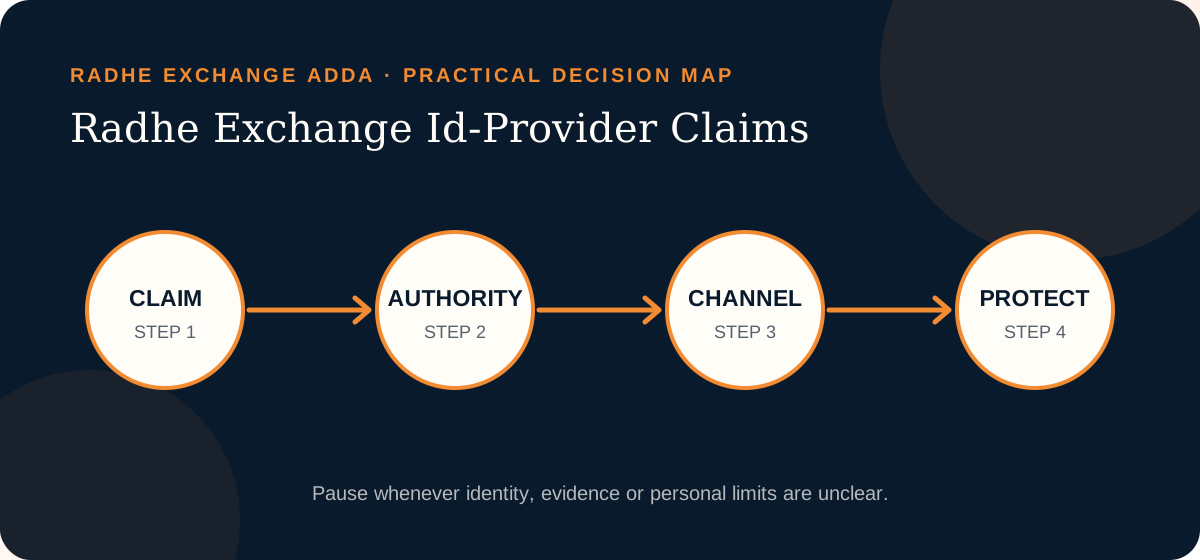
Radhe Exchange Adda decision map: move from evidence to limits and stop whenever a material check remains unresolved.
Terminology
Words that matter when assessing Radhe Exchange ID-provider claims
In a Radhe Exchange ID-provider claims decision, familiar terms may carry a precise security, legal or financial meaning. These conservative definitions help a reader evaluate identity, authority and secure communication without allowing a promotional phrase or a person offering an ID through messaging or asking for documents to stand in for evidence.
ID provider
A person or channel claiming it can arrange account credentials or access for another service. In this Radhe Exchange ID-provider claims context, use the term precisely: ask who supplies the information, what can be checked, and what consequence follows if the assumption is wrong. Clear vocabulary keeps a persuasive label from doing the work of evidence.
Authority
Verifiable permission to act on behalf of a named accountable organisation. In this Radhe Exchange ID-provider claims context, use the term precisely: ask who supplies the information, what can be checked, and what consequence follows if the assumption is wrong. Clear vocabulary keeps a persuasive label from doing the work of evidence.
Impersonation
Using a familiar identity, logo or tone to make an unauthorised contact appear genuine. In this Radhe Exchange ID-provider claims context, use the term precisely: ask who supplies the information, what can be checked, and what consequence follows if the assumption is wrong. Clear vocabulary keeps a persuasive label from doing the work of evidence.
Secure channel
A communication route established independently rather than supplied by the person being checked. In this Radhe Exchange ID-provider claims context, use the term precisely: ask who supplies the information, what can be checked, and what consequence follows if the assumption is wrong. Clear vocabulary keeps a persuasive label from doing the work of evidence.
Document exposure
The privacy and identity risk created when sensitive records are sent to an unverified recipient. In this Radhe Exchange ID-provider claims context, use the term precisely: ask who supplies the information, what can be checked, and what consequence follows if the assumption is wrong. Clear vocabulary keeps a persuasive label from doing the work of evidence.
Step by step
Five ordered checks for Radhe Exchange ID-provider claims
The order supports the goal of testing whether an agent or account seller has a verifiable role. Starting with a person offering an ID through messaging or asking for documents lets another party control the route; starting with the task, source and limits keeps this Radhe Exchange ID-provider claims decision reversible until the important questions are answered.
Ask for accountable identity
Request the legal or organisational party behind the claimed role. A display name, profile photograph and branded graphic can all be copied. For this Radhe Exchange ID-provider claims check, record what you inspected and which source supported it. If the answer depends only on a person offering an ID through messaging or asking for documents, mark it unresolved instead of filling the gap with confidence.
Verify through another route
Contact the named organisation using details found independently. Do not use the phone number or link supplied by the person being checked. For this Radhe Exchange ID-provider claims check, record what you inspected and which source supported it. If the answer depends only on a person offering an ID through messaging or asking for documents, mark it unresolved instead of filling the gap with confidence.
Limit document exposure
Do not send identity files until purpose, necessity, retention and recipient are clear. Add a watermark when a legitimate process allows it. For this Radhe Exchange ID-provider claims check, record what you inspected and which source supported it. If the answer depends only on a person offering an ID through messaging or asking for documents, mark it unresolved instead of filling the gap with confidence.
Reject secret handling
Never share a password, OTP, UPI PIN, card PIN or remote-control session. Authority to assist does not require authority over personal secrets. For this Radhe Exchange ID-provider claims check, record what you inspected and which source supported it. If the answer depends only on a person offering an ID through messaging or asking for documents, mark it unresolved instead of filling the gap with confidence.
Preserve and report
Save the profile, number, domain, request and payment details if impersonation is suspected. Use verified reporting routes rather than continuing the confrontation. For this Radhe Exchange ID-provider claims check, record what you inspected and which source supported it. If the answer depends only on a person offering an ID through messaging or asking for documents, mark it unresolved instead of filling the gap with confidence.
Decision table
Turn Radhe Exchange ID-provider claims signals into specific responses
A signal matters when it changes behaviour. For Radhe Exchange ID-provider claims, the table avoids unsupported “safe” or “unsafe” labels and instead connects each observation about identity, authority and secure communication to a proportionate next action.
Signal
Why it matters
Safer response
Profile identity
Names, photos and logos can be copied or changed instantly.
Verify authority through the claimed organisation. For Radhe Exchange ID-provider claims, keep the next action proportionate to the possible exposure.
Urgent KYC
Time pressure can push identity documents into an insecure chat.
Pause until recipient and handling rules are established. For Radhe Exchange ID-provider claims, keep the next action proportionate to the possible exposure.
Secret request
Passwords and OTPs give control rather than prove identity.
Never disclose them to a provider or agent. For Radhe Exchange ID-provider claims, keep the next action proportionate to the possible exposure.
Personal beneficiary
Payment to an unrelated name weakens accountability.
Stop and verify the legal recipient before transfer. For Radhe Exchange ID-provider claims, keep the next action proportionate to the possible exposure.
Verification notes
Build a concise record for Radhe Exchange ID-provider claims
Write down the unresolved point
For Radhe Exchange ID-provider claims, record the exact question before opening another result or message. The working question is whether identity, authority and secure communication can support the goal of testing whether an agent or account seller has a verifiable role. Note the hostname, date, source and the claim in its original context. This small record prevents a later page from quietly changing the issue and makes “still unknown” a usable conclusion rather than an uncomfortable gap.
Compare conflicts by source quality
When two pages disagree about Radhe Exchange ID-provider claims, do not count how many repeat each position. Ask which source is accountable, current, independent of a person offering an ID through messaging or asking for documents, and directly relevant to the fact being checked. Prefer a narrow supported statement over a broad reassuring one. If neither side meets that standard, retain both links, label the conflict unresolved and avoid any action that would expose credentials, identity, device access or money.
Record why you stopped
A no-action decision protects future choices. Write the stop reason in practical language: the identity was unclear, the terms could not be retained, the legal context needed advice, or the request exceeded the chosen limit. For this Radhe Exchange ID-provider claims page, use this standing rule: A confident claim of affiliation is not proof of authority. Recording the reason reduces the chance that a later countdown, different contact or newly designed page restarts the same decision without resolving the original problem.
Risks and common mistakes
Where a Radhe Exchange ID-provider claims decision can lose focus
For Radhe Exchange ID-provider claims, mistakes often begin with a person offering an ID through messaging or asking for documents, a plausible explanation or one small exception—not deliberate recklessness. Naming those patterns before working toward this page’s goal—testing whether an agent or account seller has a verifiable role—makes them easier to recognise under pressure.
Profile identity
Names, photos and logos can be copied or changed instantly. This matters when the practical task is testing whether an agent or account seller has a verifiable role. The safer response is simple: verify authority through the claimed organisation. A pause preserves choices; urgency usually removes them.
Urgent KYC
Time pressure can push identity documents into an insecure chat. This matters when the practical task is testing whether an agent or account seller has a verifiable role. The safer response is simple: pause until recipient and handling rules are established. A pause preserves choices; urgency usually removes them.
Secret request
Passwords and OTPs give control rather than prove identity. This matters when the practical task is testing whether an agent or account seller has a verifiable role. The safer response is simple: never disclose them to a provider or agent. A pause preserves choices; urgency usually removes them.
Personal beneficiary
Payment to an unrelated name weakens accountability. This matters when the practical task is testing whether an agent or account seller has a verifiable role. The safer response is simple: stop and verify the legal recipient before transfer. A pause preserves choices; urgency usually removes them.
Practical scenarios
Three realistic Radhe Exchange ID-provider claims situations
These are decision exercises, not claims about Radhe Exchange operations. Each applies the rule “a confident claim of affiliation is not proof of authority” while showing how a reader can preserve credentials, money, data or wellbeing without guessing the sender’s motive.
An agent offers an ID
Situation: The profile uses brand graphics and says the process is authorised.
Reasoned response for Radhe Exchange ID-provider claims: The reader verifies the role through the named organisation and sends no documents or money during the check. The useful result for a Radhe Exchange reader is a controlled process, not a perfect prediction or a decision dictated by one unverified prompt.
A KYC image is requested in chat
Situation: The sender asks for both sides of an identity document immediately.
Reasoned response for Radhe Exchange ID-provider claims: The reader stops until a secure route, purpose and retention policy are independently established. The useful result for a Radhe Exchange reader is a controlled process, not a perfect prediction or a decision dictated by one unverified prompt.
A new number continues the case
Situation: A message says the old support line has changed and payment should go elsewhere.
Reasoned response for Radhe Exchange ID-provider claims: The reader treats continuity as broken and re-verifies both authority and beneficiary. The useful result for a Radhe Exchange reader is a controlled process, not a perfect prediction or a decision dictated by one unverified prompt.
Questions and answers
Focused answers about Radhe Exchange ID-provider claims
What is the first check for Radhe Exchange ID-provider claims?
State the exact task and expected destination before acting. Then test identity, authority and secure communication through a source that is independent of a person offering an ID through messaging or asking for documents. This prevents a broad brand search from becoming accidental consent, credential disclosure or payment. This editorial guide cannot make the decision safe by itself; it can only make the unresolved questions visible.
Does a polished Radhe Exchange page prove it is official?
No. For Radhe Exchange ID-provider claims, design, HTTPS, logos and search position can be useful technical or navigation signals, but none establishes operator identity on its own. Confirm the accountable party and exact hostname outside the page before relying on official-looking presentation. This editorial guide cannot make the decision safe by itself; it can only make the unresolved questions visible.
What should I save while checking?
Keep the exact URL, relevant terms, recipient or publisher details, timestamps and the source used for verification. For Radhe Exchange ID-provider claims, a contemporaneous record is more reliable than remembering a screen after it changes or disappears. This editorial guide cannot make the decision safe by itself; it can only make the unresolved questions visible.
When is leaving the right decision?
Leave when pressure rises while identity, legality, terms or personal limits remain unclear. Also stop at any request for a password, OTP, UPI PIN, remote-control access or unexplained payment. A confident claim of affiliation is not proof of authority. This editorial guide cannot make the decision safe by itself; it can only make the unresolved questions visible.
Related next steps
Choose the next guide after this Radhe Exchange ID-provider claims check
Keep the goal of testing whether an agent or account seller has a verifiable role separate from later access, registration, payment or legal questions. If the task changes, open the matching guide and begin again with its evidence. Do not carry trust from a person offering an ID through messaging or asking for documents into another domain, person or decision without verification.
Hello! 👋 Do you want to Create your IPL Cricket Betting ID ?
Kisi bhi top bookie (Reddy Anna, Lotus, etc.) se apni Betting ID lo, fatak se 60 seconds mein. Tension-free khelo kyunki humara 24/7 live chat support hamesha aapke saath hai.